
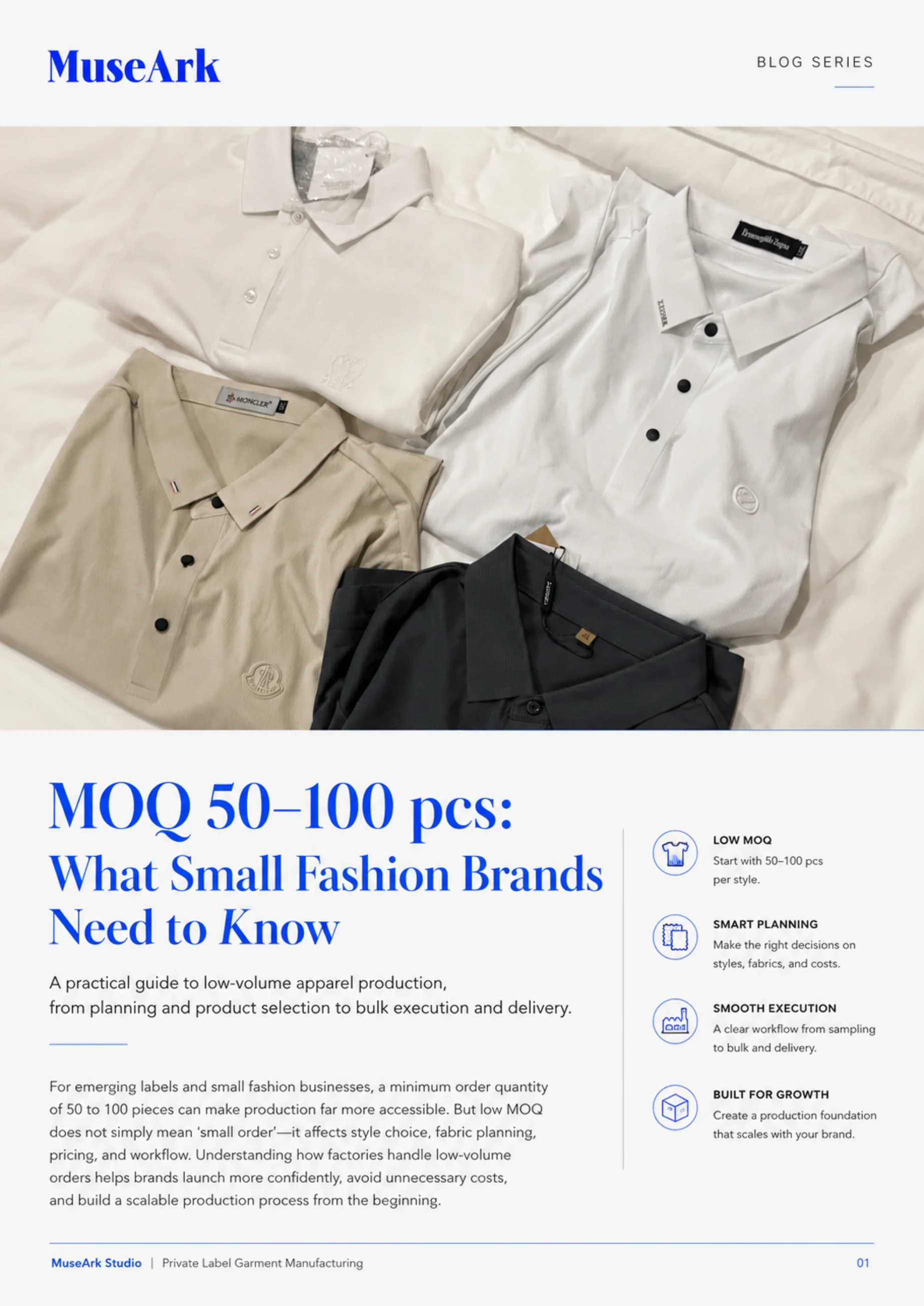
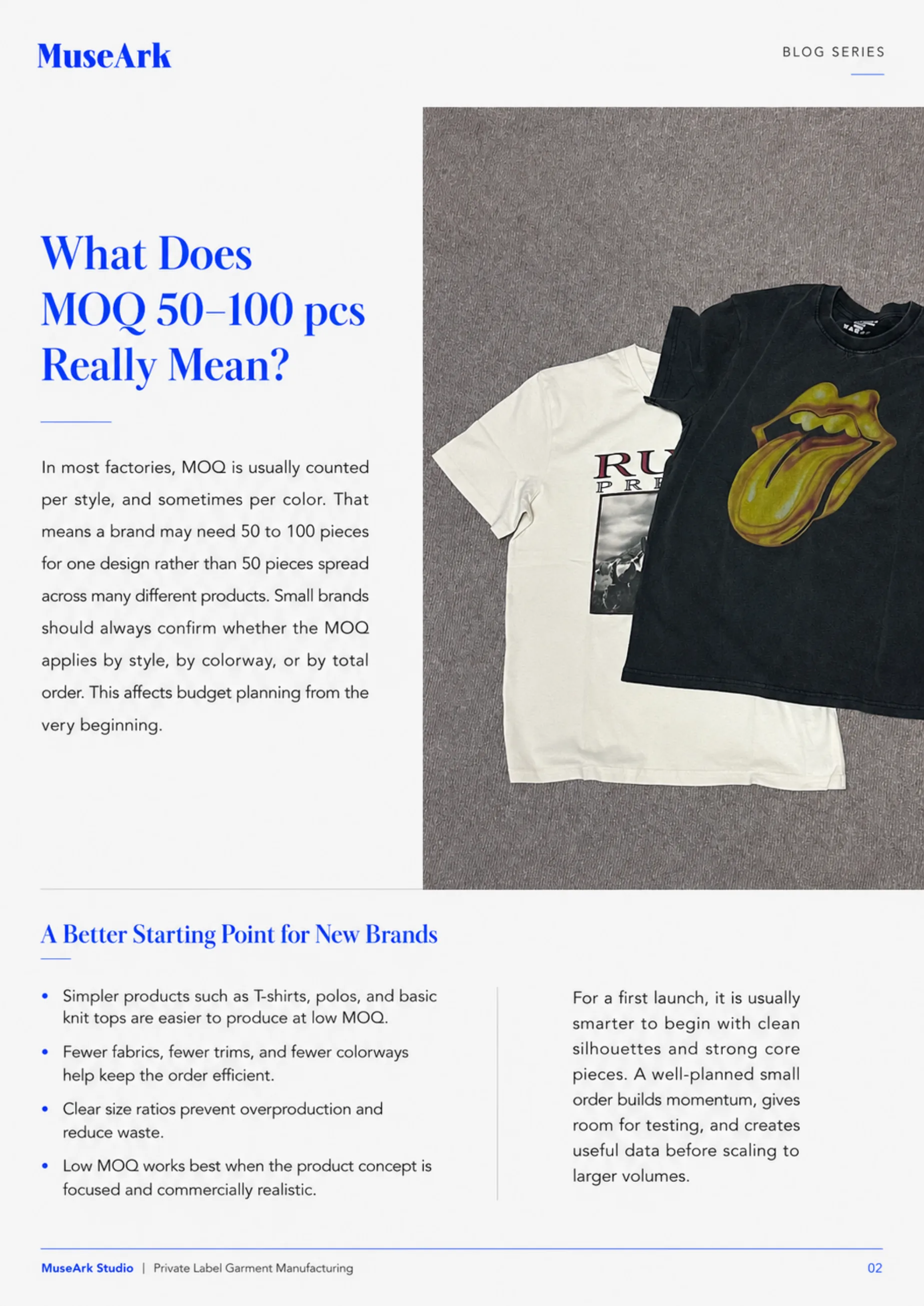
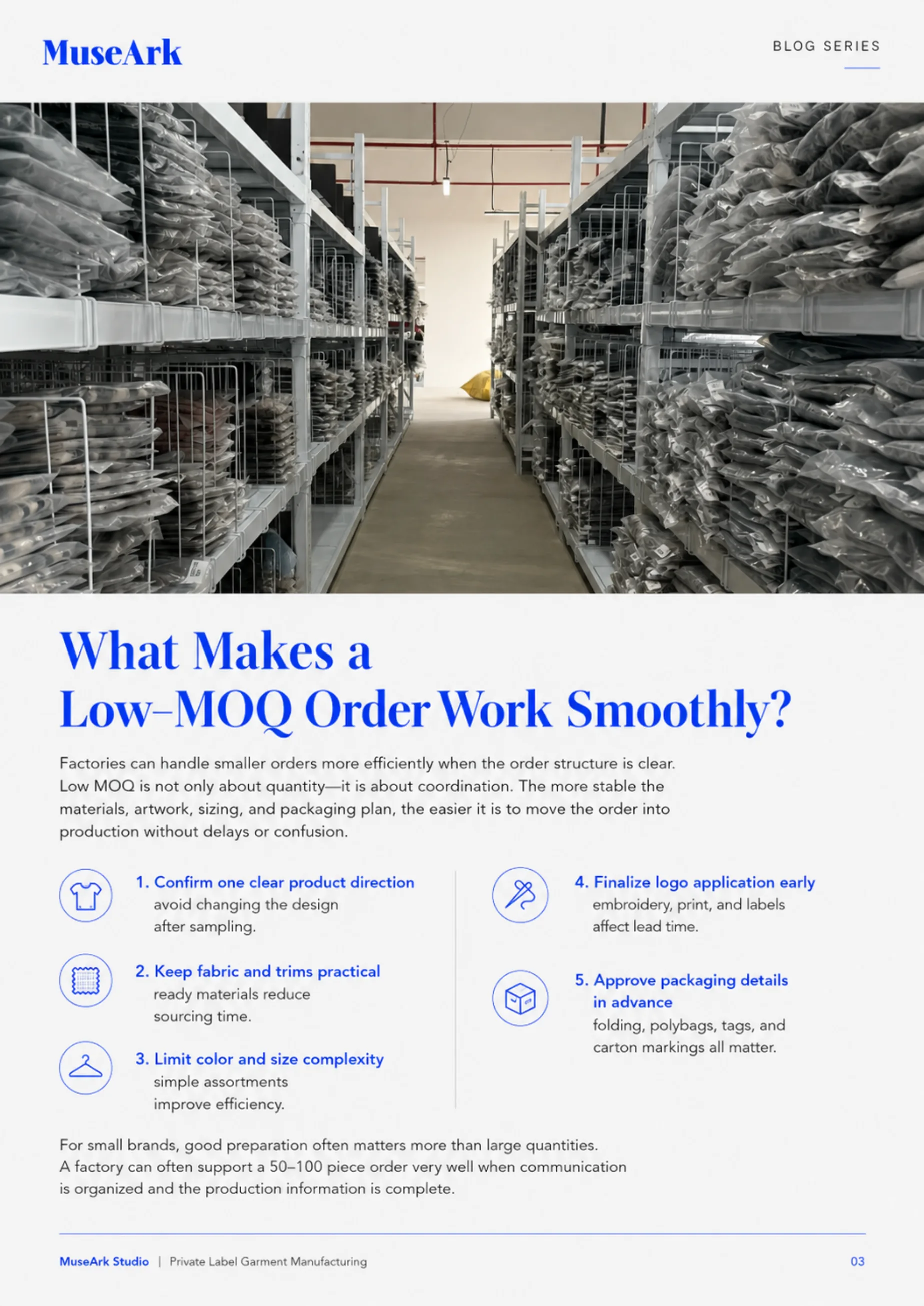
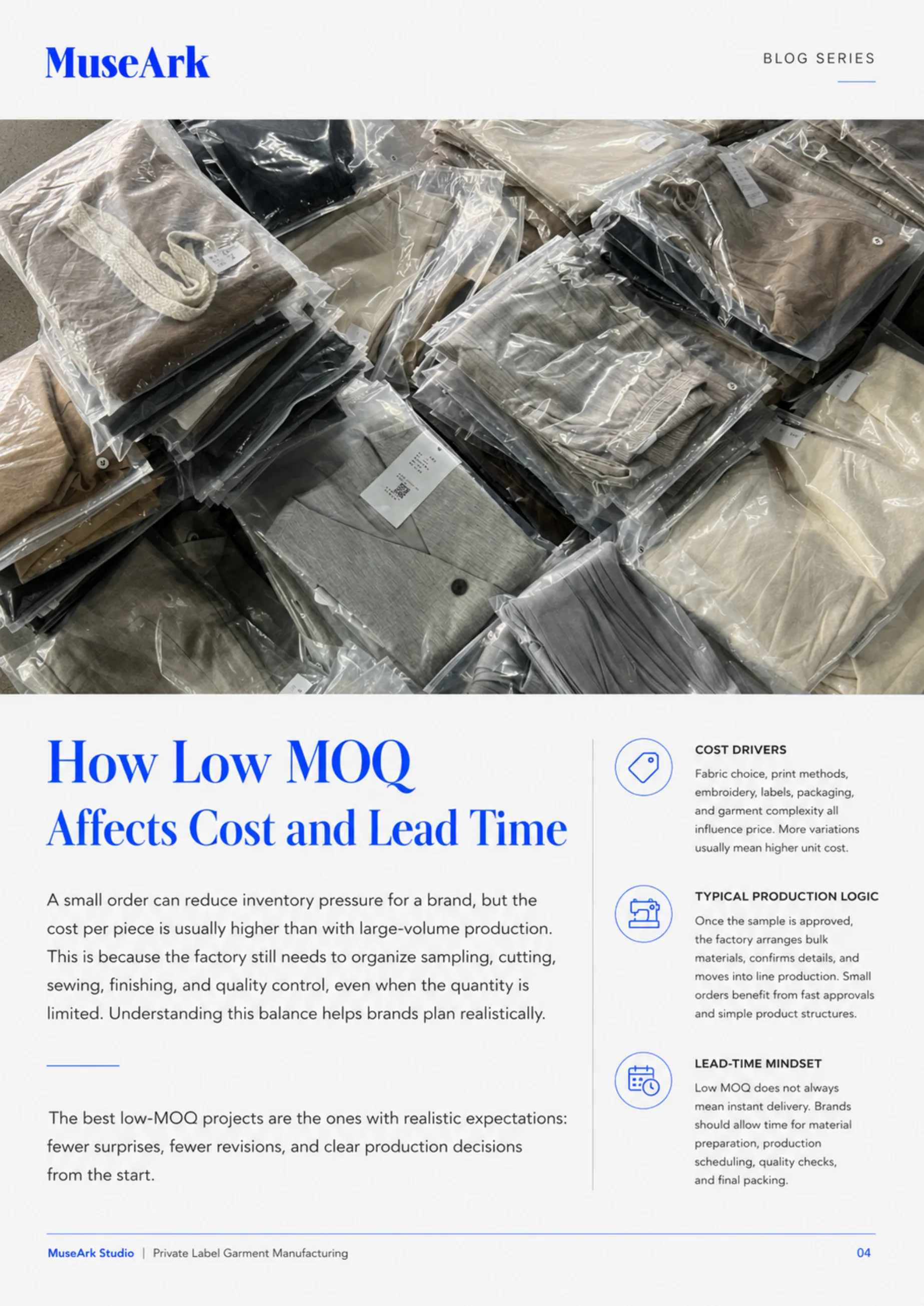
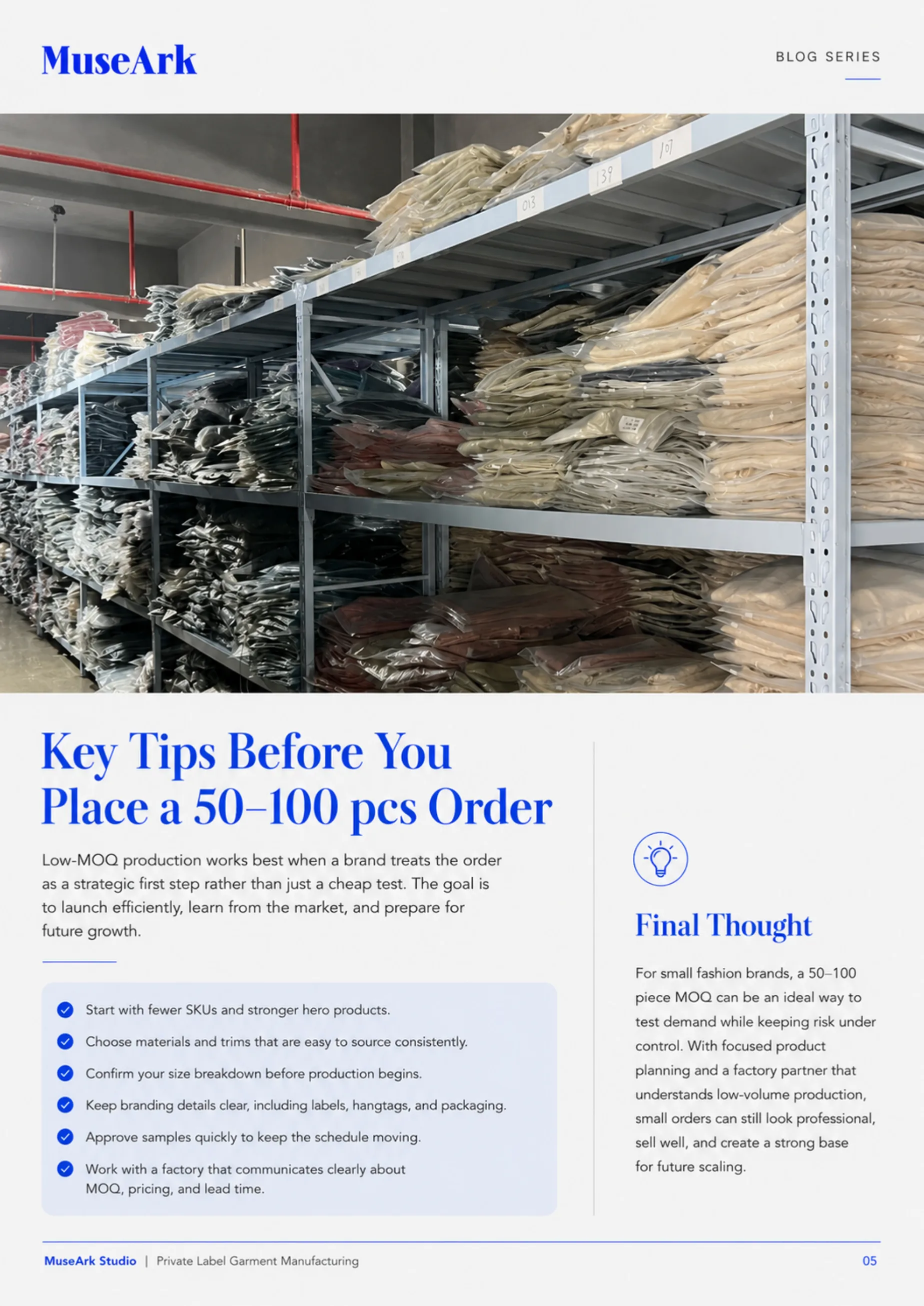
50-100 pieces can be made, but the route usually works best for one style, limited colors, and available fabric. Custom fabric, multiple colorways, and complex washing can raise the production threshold or the unit cost. That is the practical meaning of working with a low MOQ clothing manufacturer. Brands comparing a 50 piece clothing manufacturer or 100 piece clothing manufacturer should ask how the quantity is counted across style, color, fabric, and decoration.
A small-batch order can be a useful first drop or market test, but it still needs a clear product brief, sample approval, and production reference. For the specification inputs a factory needs, see tech pack vs reference photos.
01 / 50, 100, or 200+ Pieces?
| Quantity | Suitable projects | Unit cost trend | Color and fabric limits | Recommended approach |
|---|---|---|---|---|
| 50 pcs | Market test, focused capsule, one proven product route | Highest per-piece pressure because fixed setup costs are spread across fewer units | Usually one style, few colors, and available fabric or trims | Keep construction and decoration practical; approve one clear sample before bulk |
| 100 pcs | Small first drop or a focused repeatable style | Often more efficient than 50 pcs, but still sensitive to setup and decoration costs | Some flexibility for size and color allocation, subject to the material route | Concentrate quantity into one style and limit variations that create separate setups |
| 200+ pcs | Validated styles, stronger size coverage, or a controlled multi-color run | Usually better fixed-cost absorption; no fixed price is implied | More room for color and size planning, while custom fabric may still have its own mill MOQ | Use approved specifications and plan material, decoration, and QC checkpoints before booking |
02 / What Can Usually Work at 50-100 Pieces
- One clear style with a defined fit, size range, and production reference.
- An available fabric or a fabric already supported by the factory, with a confirmed composition and GSM.
- One or two controlled colorways, with quantity allocated clearly by color and size.
- Simple print, embroidery, label, and packaging requirements that do not create many separate setups.
- A standard sample and approval route with consolidated brand feedback.
03 / What Often Needs a Higher MOQ
Custom fabric development can carry a separate mill minimum even when the garment factory accepts 50 pieces. Multiple colors may require separate dye lots, while complex washes, special trims, many decoration placements, and extensive packaging customization add setup and control work. A low-MOQ clothing manufacturer may still review these projects, but the practical result can be a higher minimum, a higher unit cost, or a recommendation to simplify the first run.
04 / What a Factory Needs Before Quoting Low MOQ
| Input | What to provide | Why it affects the quote |
|---|---|---|
| Style | Product type, reference images or tech pack, fit, construction, and size range | Defines pattern work, sewing operations, and sample requirements |
| Quantity | Total units plus quantity by color and size | Shows whether the run is concentrated enough to support each material and setup |
| Fabric / GSM | Composition, weight, color, available option or custom development direction | Determines material MOQ, lead time, and sourcing route |
| Process | Print, embroidery, wash, dye, special construction, and finishing details | Each process can add setup, testing, labor, or development time |
| Labels / packing | Labels, hangtags, folding, polybags, stickers, and carton requirements | Packaging and trims can have their own minimums and setup costs |
| Destination / timing | Delivery country or city, target date, and shipping preference | Allows realistic planning for sample, production, QC, packing, and shipment |
05 / Why Small Runs Cost More Per Piece
The unit price is not only the fabric and sewing labor. A 50-100 piece order spreads fixed work across fewer garments:
- Pattern and sample development: the same technical decisions may be needed for a small run as for a larger one.
- Cutting and sewing setup: markers, line preparation, and handling are less efficiently absorbed.
- Print and embroidery: artwork setup, screens, digitizing, test pieces, and placement checks remain part of the route.
- Wash and finishing: testing, color control, shrinkage review, and handling can be significant for a small lot.
- Labels, packaging, and QC: trims, packing materials, inspection time, and shipment preparation still need to be completed.
There is no honest fixed low-MOQ price without the product and material details. The best way to manage the per-piece cost is to concentrate the quantity, use a suitable available route, and avoid late changes after sampling. For timing, reserve sample and approval time in the hoodie sampling timeline.
06 / Sampling and Delivery Planning
MOQ does not remove sampling. A brand should approve fit, fabric hand feel, measurements, decoration, wash result, labels, and packaging before bulk. For a t-shirt or jersey first run, review the custom T-shirt manufacturing program alongside the hoodie route. Production planning should then include sample development, brand review, material preparation, bulk, QC, packing, and shipment. The broader MuseArk production process shows how those decisions move from brief to handoff.
Typical Production Planning for a Low-MOQ Run
| Planning point | Typical range | What changes it |
|---|---|---|
| Typical MOQ | 50+ pcs for one focused style | Available fabric, limited colorways, and practical decoration keep a small run workable. |
| Sample development | 7-14 days after the brief and material route are confirmed | New patterns, washes, embroidery, or missing specifications can add review and revision time. |
| Bulk production after approval | 4-8 weeks after sample approval | Material availability, order quantity, color splits, trims, and the approval speed affect the final schedule. |
These planning ranges depend on fabric, process, order quantity, and how quickly specifications and sample feedback are confirmed. Review the custom T-shirt manufacturing program when a jersey or T-shirt route is a better fit for the first run.
Factory Takeaway
50-100 pieces are most workable when a small brand makes fewer, clearer decisions: one focused style, limited color variation, a practical fabric route, controlled decoration, and an approved sample. That is how small batch clothing production stays commercially useful instead of becoming an expensive collection of exceptions.
Request a Low MOQ Quote
Share your style references, quantity by color and size, fabric or GSM direction, decoration, wash, destination, and target delivery date. We will review the practical low-MOQ route before quoting.
Request a Low MOQ QuoteFrequently Asked Questions
Can I order only 50 pieces?
Yes, 50 pieces can be workable for a focused style with limited colors, an available fabric, and practical decoration. Custom fabric, multiple colorways, complex washing, or many size and trim variations may require a higher MOQ or a higher unit cost.
Is MOQ per color or per style?
MOQ can be assessed per style, color, fabric route, or a combination of these depending on the factory and materials. Confirm how the quantity is counted before quoting, especially when splitting 50 or 100 pieces across several colors.
Can I use custom fabric at low MOQ?
Sometimes, but custom fabric usually has its own mill minimum, color minimum, development lead time, and setup cost. An available fabric or close substitute is often more practical for a 50-100 piece first run.
Does MOQ include samples?
MOQ normally refers to the bulk production quantity and does not automatically include development samples. Sample quantity, sample charges, shipping, and whether approved samples are credited should be confirmed separately.