
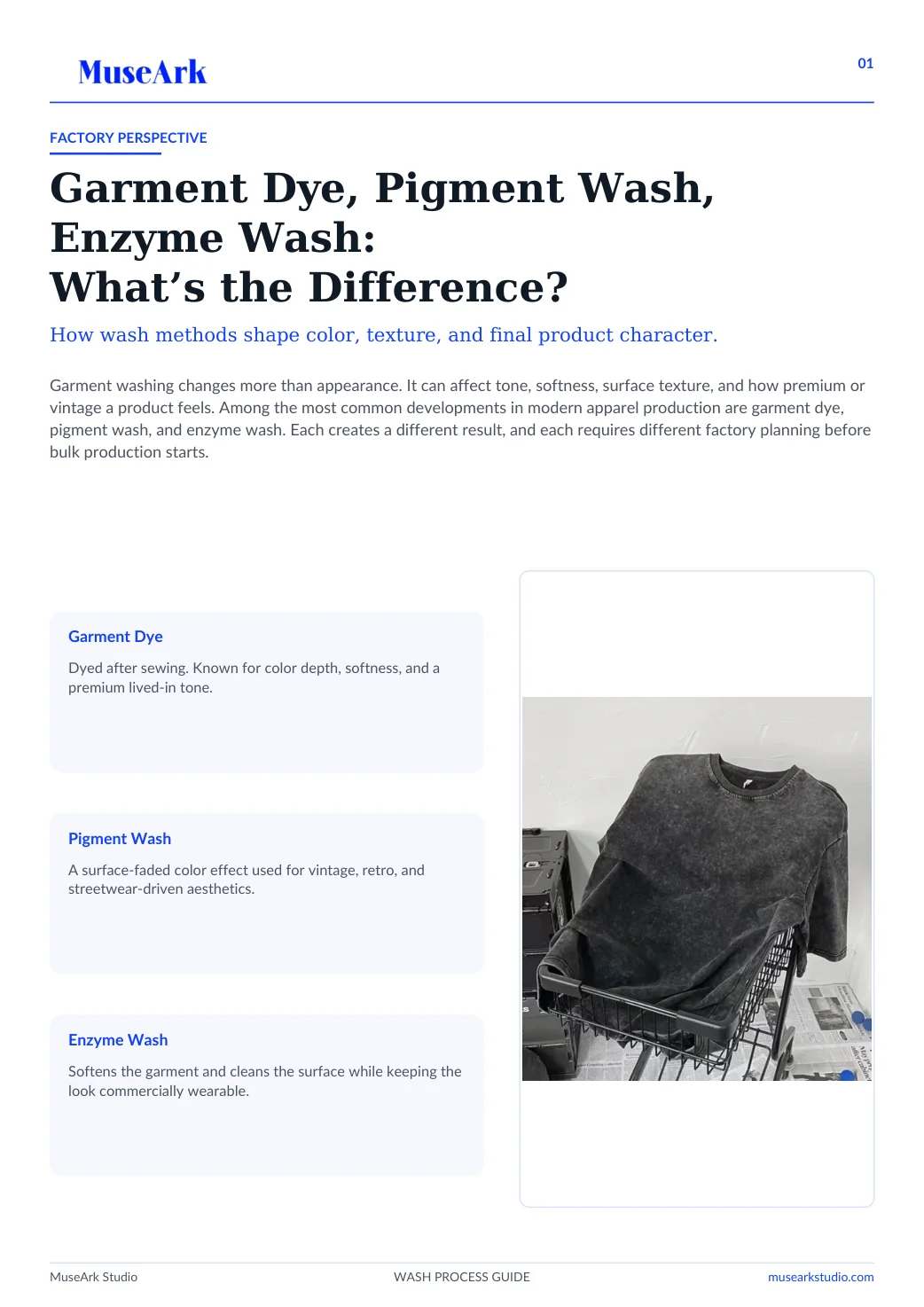
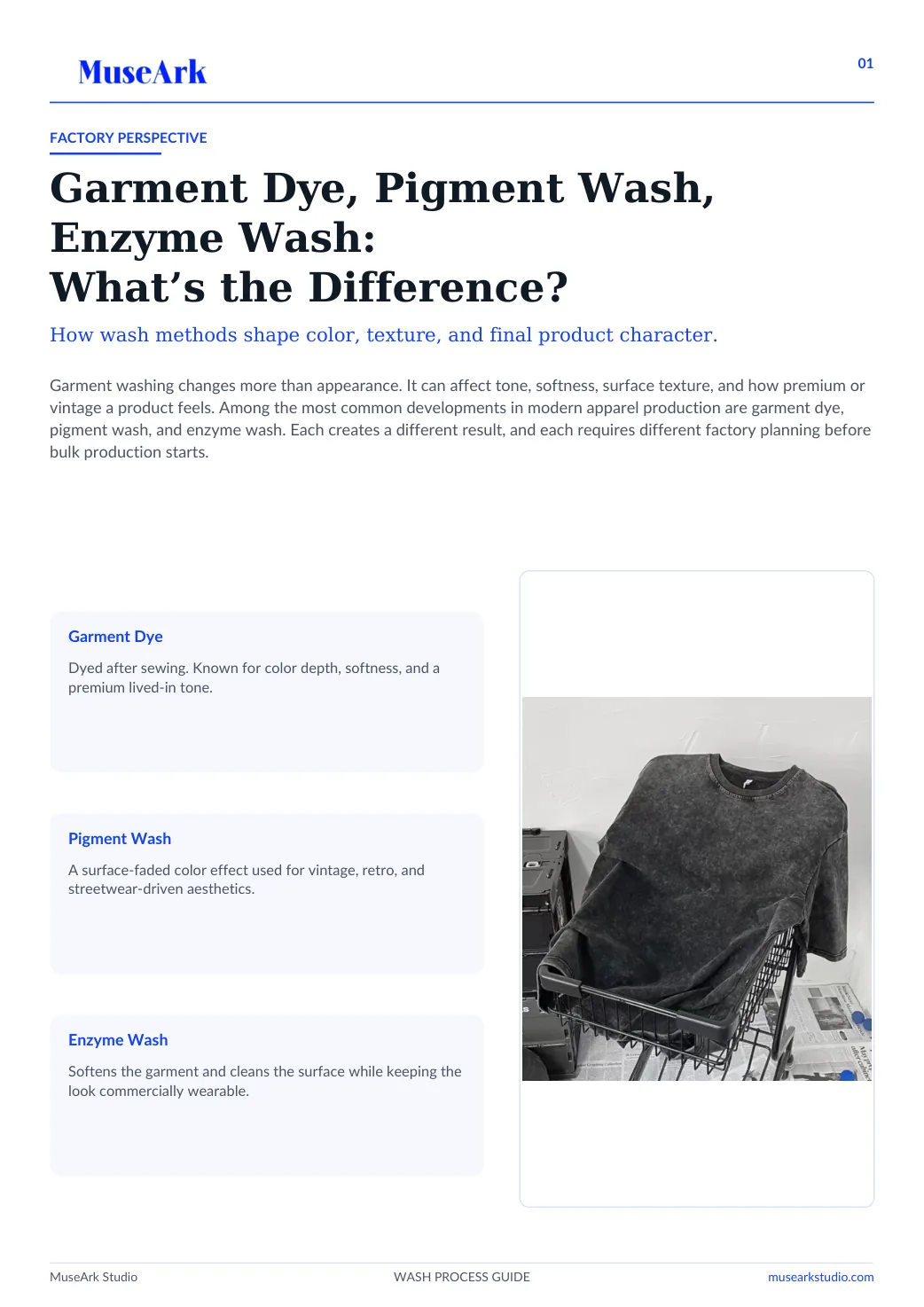
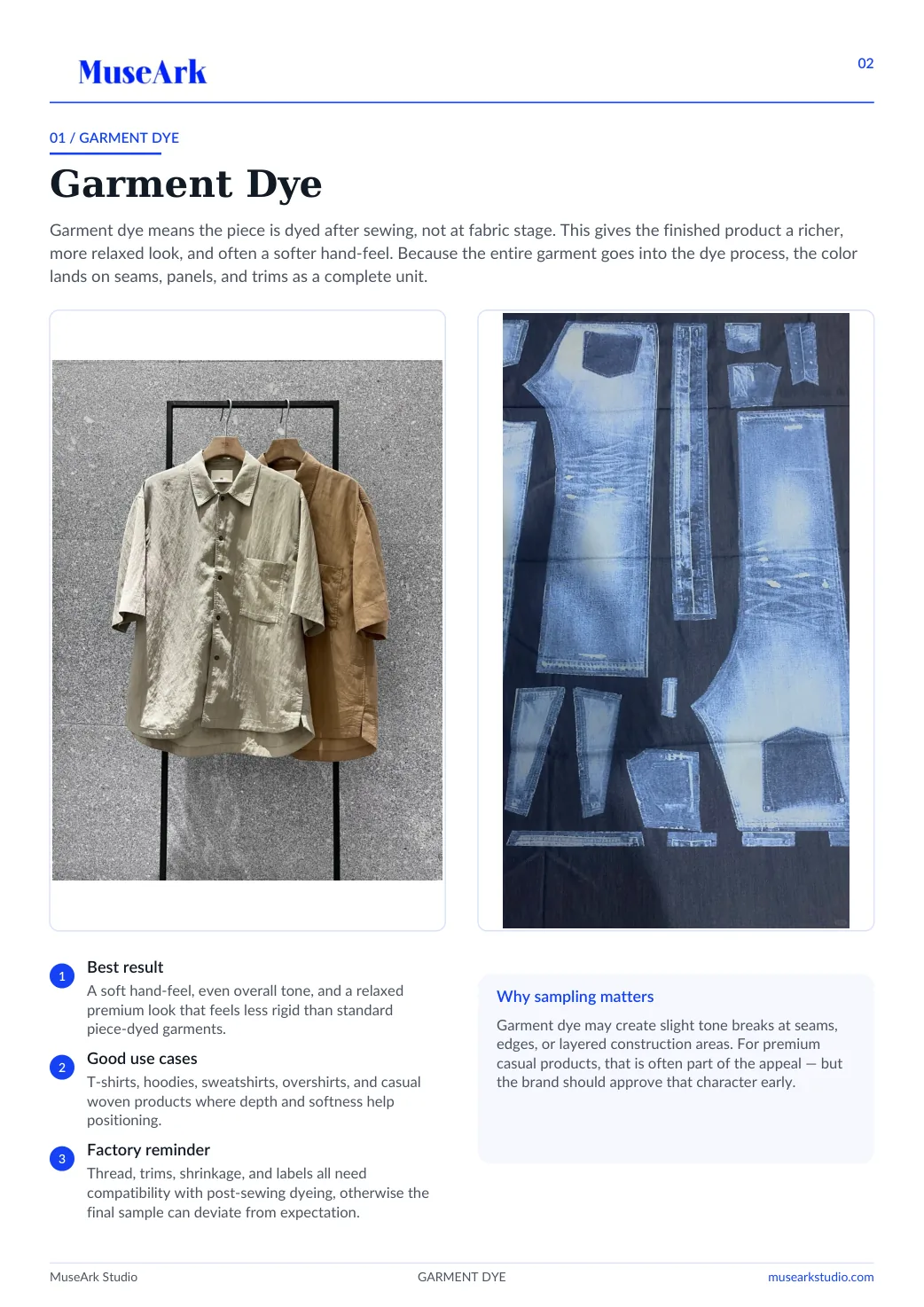
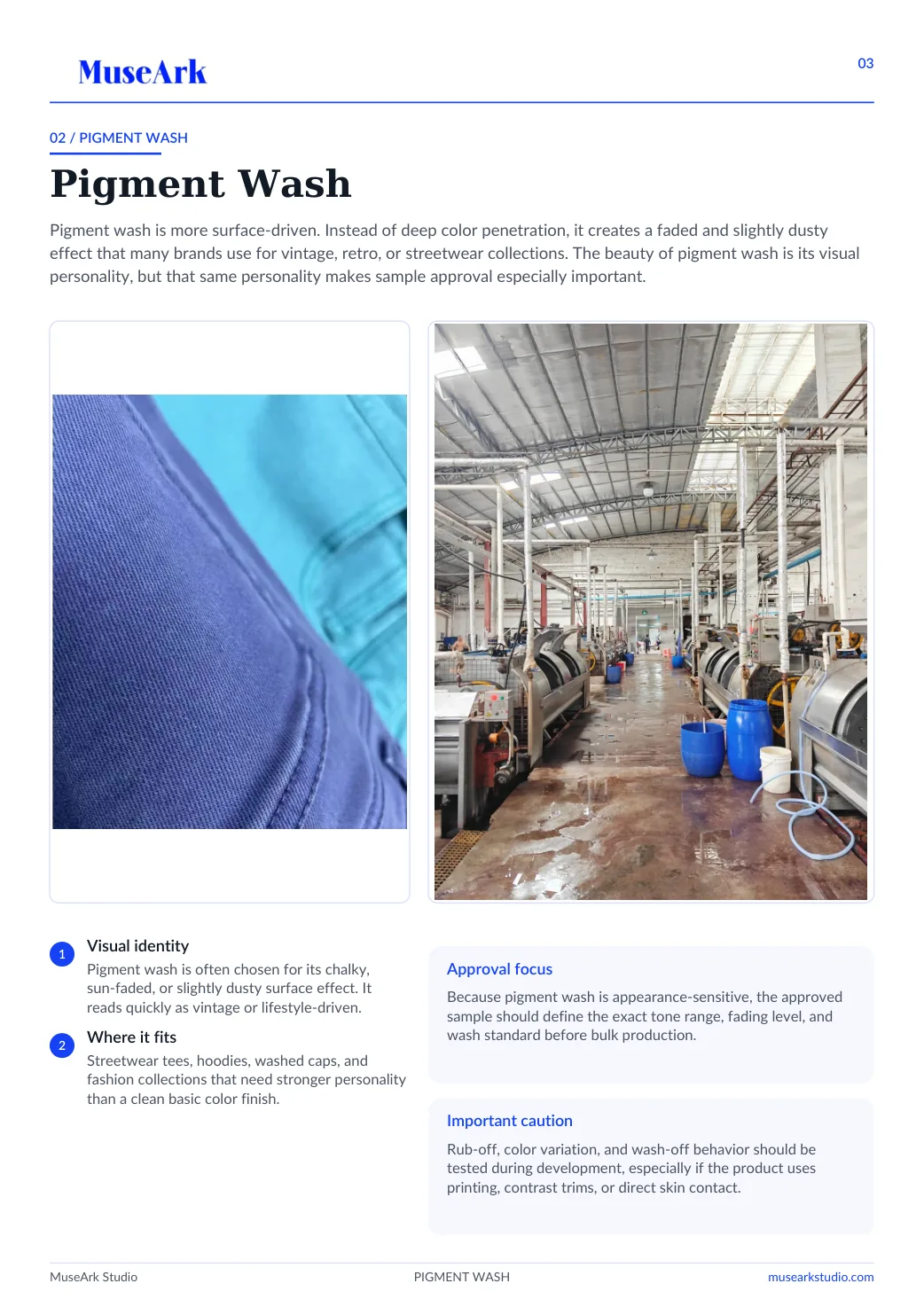
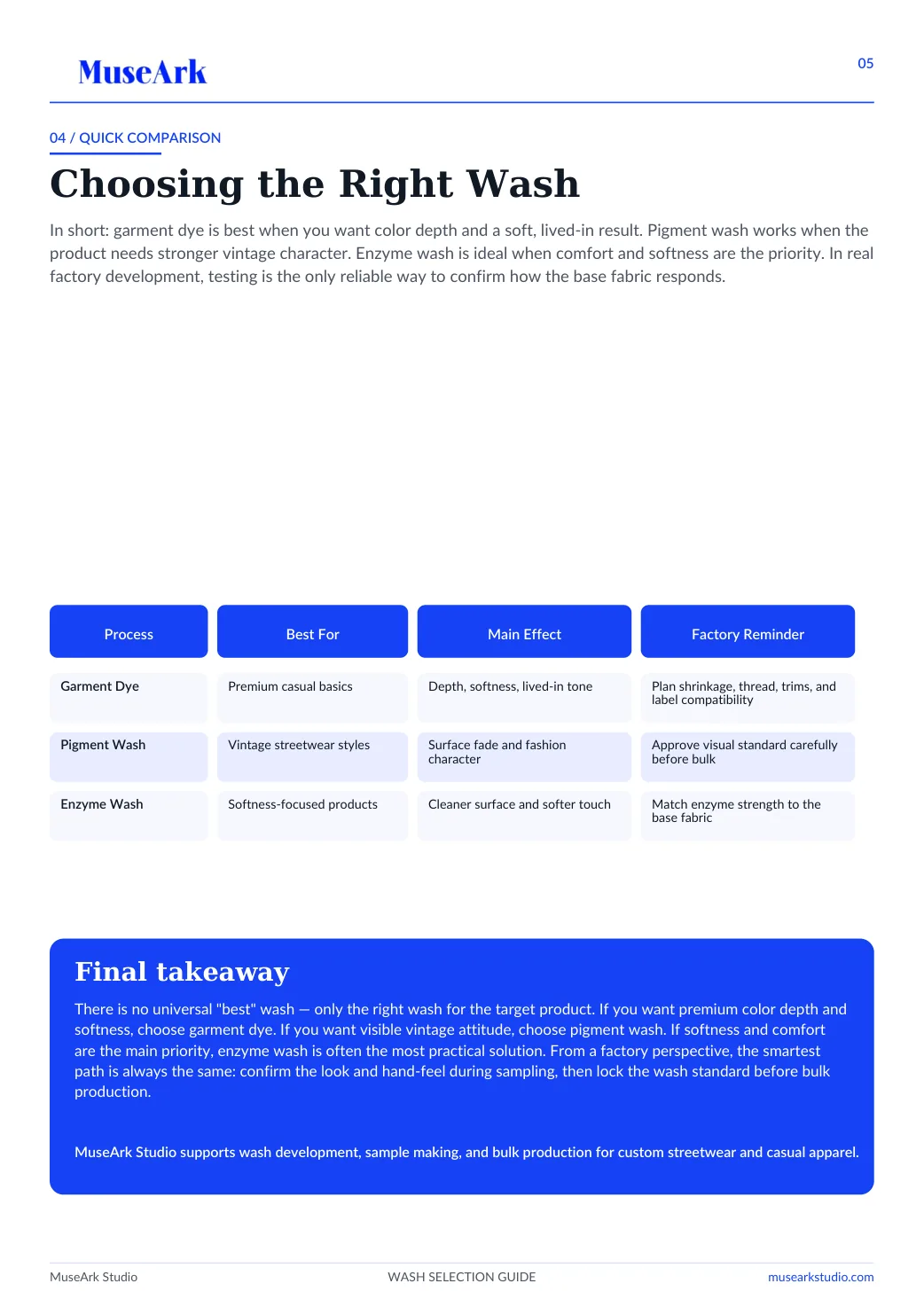
Want overall color and natural variation? Choose Garment Dye. Want a faded vintage surface? Choose Pigment Wash. Want a cleaner surface and softer hand feel? Choose Enzyme Wash. That is the short answer to garment dye vs pigment wash vs enzyme wash; the correct route depends on the product, base fabric, decoration, and approval standard.
For washed hoodies, the finish also changes measurements and production planning. Review how garment wash changes measurements, then allow time for wash sampling and approvals in the hoodie sampling timeline. A clear tech pack or reference brief helps the factory separate the intended wash effect from the other specifications.
When labels, patches, packaging, or other components must perform through the wash route, review the custom trims and finishes program alongside the garment finish.
01 / What Each Wash Route Does
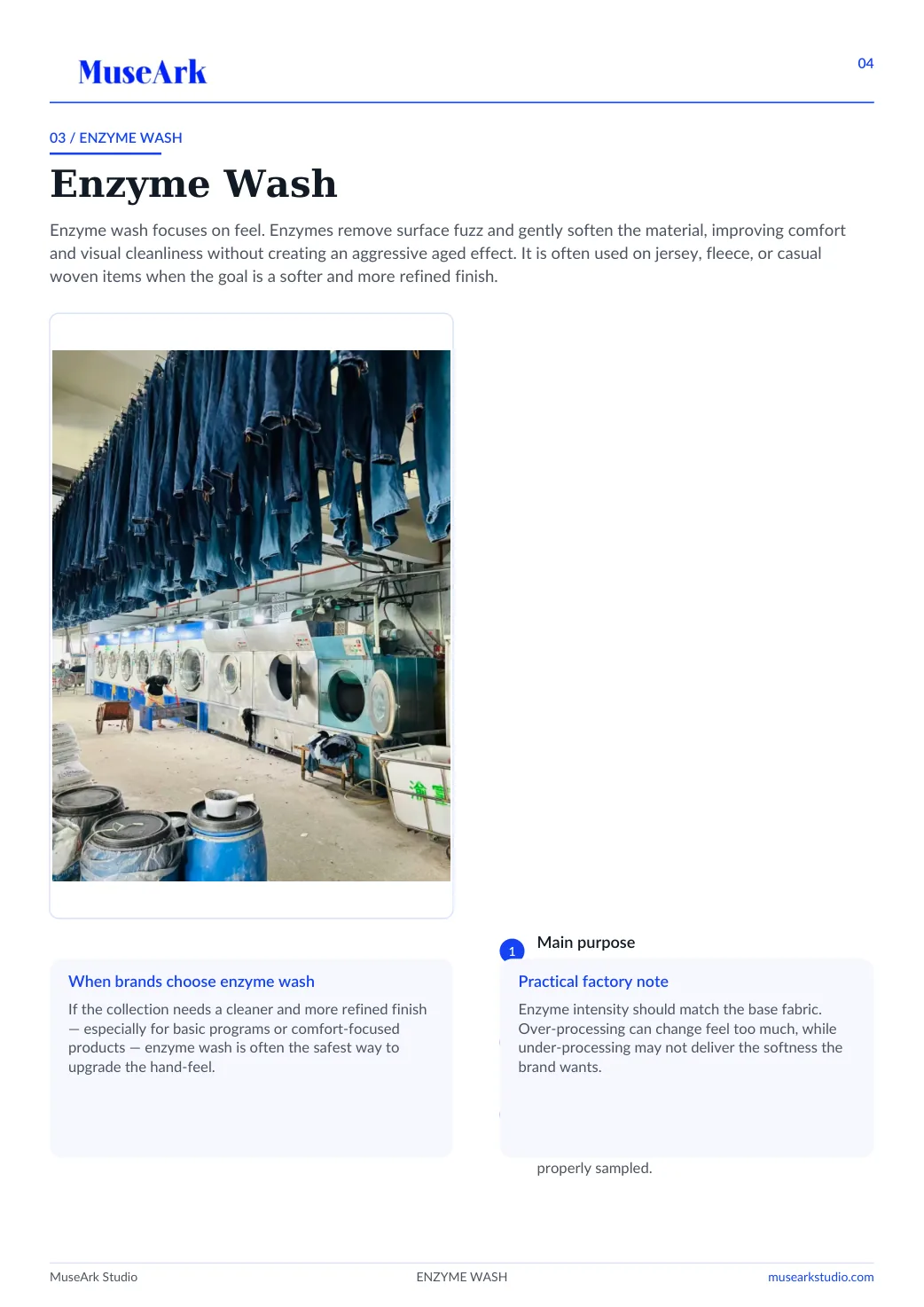
Garment dye colors the sewn garment rather than only the fabric. It can create depth and natural variation across seams, panels, and layers, with a relaxed hand feel. Pigment wash creates a surface-led faded or dusty character, often used for vintage and streetwear products. Enzyme wash works mainly on the surface, reducing fuzz and improving softness and cleanliness without needing an aggressive aged look. The pigment wash vs enzyme wash decision is therefore mainly about visible surface character versus a cleaner, softer finish.
02 / Wash Route Comparison
| Process | Visual effect | Hand feel | Best products | Color variation | Development risks | Relative time and cost |
|---|---|---|---|---|---|---|
| Garment dye | Deep, relaxed, naturally uneven color across the sewn garment | Soft and lived-in, depending on base fabric and route | T-shirts, hoodies, sweatshirts, overshirts, casual wovens | Medium to high; seam and panel variation can be part of the look | Shrinkage, shade variation, trim and thread compatibility, size change | Medium to high; color and measurement approval can add development time |
| Pigment wash | Faded, dusty, vintage surface with visible wash character | Soft with a dry or worn surface feel | Vintage tees, streetwear hoodies, fleece, casual bottoms | High; tone range, rub-off, and wash-off need control | Rub-off, uneven fading, print compatibility, shrinkage, repeatability | Medium to high; testing and shade approval are important |
| Enzyme wash | Cleaner, smoother surface with limited intentional aging | Soft, cleaner, and often smoother to touch | Jersey, fleece, French terry, casual woven basics | Low to medium, but tone can still shift with intensity and sequence | Over-processing, weakened surface, color change, inconsistent softness | Low to medium relative route; intensity still needs a controlled sample |
03 / How to Choose a Wash Route
| Your priority | Best starting route | Confirm before bulk |
|---|---|---|
| Overall color depth and natural tonal variation | Garment dye | Shade range, seam variation, shrinkage, labels, trims, and final measurements |
| Vintage, faded, surface-driven character | Pigment wash | Fading level, rub-off, color range, print or embroidery compatibility, and hand feel |
| Softness and a cleaner surface | Enzyme wash | Softness level, surface strength, color shift, shrinkage, and repeatability |
| A washed printed or embroidered hoodie | Start with pigment or enzyme testing against the decoration | Decoration adhesion, distortion, placement, color behavior, and finished dimensions |
There is no universal best wash for hoodies. The custom hoodie manufacturing program can be planned around the intended fleece or French terry, fit, decoration, and finish rather than choosing the wash in isolation.
04 / What Must Be Approved During Wash Sampling
Wash approval should record the complete finished garment, not only a close-looking color chip:
- Shrinkage: before-and-after body, sleeve, chest, hood, cuff, and hem measurements.
- Color difference range: approved tone, panel or seam variation, fading level, and acceptable bulk range.
- Rub and crocking: dry and wet rubbing behavior, transfer risk, and any direct-skin-contact concern.
- Print and embroidery compatibility: adhesion, cracking, distortion, stitch appearance, placement, and color after washing.
- Hand feel: softness, surface dryness, fuzz removal, stiffness, and recovery after handling.
- Finished garment dimensions: size specification, tolerances, twisting, balance, and whether the sample fabric represents bulk.
05 / Why Wash Sampling Can Extend the Schedule
Wash development can add an approval loop because the factory must evaluate color, hand feel, shrinkage, decoration, and measurements together. A route that looks right but changes the garment too much is not ready for bulk. For the full sequence from brief through sample approval, keep the hoodie sample timeline as the planning reference.
Typical Production Planning for Wash Development
| Planning point | Typical range | What changes it |
|---|---|---|
| Typical MOQ | 50+ pcs for one focused washed style | Custom colors, complex washes, and trim requirements can require a different material or process minimum. |
| Wash sample and approval | 7-14 days after the base fabric and wash target are confirmed | Wash tests, shade range, shrinkage, rub behavior, decoration compatibility, and measurement review can require another approval loop. |
| Bulk production after approval | 4-8 weeks after the approved wash sample | Fabric, wash complexity, order quantity, color confirmation, and approval speed set the final production plan. |
These planning ranges depend on fabric, process, order quantity, and how quickly wash samples and approvals are confirmed. Confirm the approved color range and final measurements before bulk is released.
Factory Takeaway
Choose garment dye for overall depth and natural variation, pigment wash for vintage surface fade, and enzyme wash for softness and surface cleanliness. Then define the approved color range, hand feel, rub behavior, decoration compatibility, shrinkage, and final dimensions before bulk production.
Request a Wash Development Review
Send your product reference, base fabric or GSM direction, target color, decoration, quantity, and desired hand feel. We will review the wash route and the approvals needed before bulk.
Request a Wash Development ReviewFrequently Asked Questions
Does garment dye cause shrinkage?
Garment dye can involve shrinkage and measurement change because the finished garment is processed after sewing. The actual result depends on the base fabric, construction, dye route, and control process, so before-and-after measurements should be checked during sampling.
Is pigment wash suitable for hoodies?
Yes. Pigment wash is often suitable for fleece, French terry, and cotton hoodies when a faded, surface-driven vintage effect is intended. The brand should approve the tone range, rub-off, hand feel, shrinkage, and decoration compatibility before bulk.
Can enzyme wash change color?
Enzyme wash is mainly selected to clean and soften the surface, but it can still change the appearance or tone depending on the fabric, dye, intensity, and wash sequence. Treat color as an approval point rather than assuming it will stay unchanged.
Which wash needs a sample?
All three routes should be sampled when the finish affects appearance, hand feel, shrinkage, color, decoration, or final garment measurements. A sample is especially important for pigment wash, garment dye, custom color, and any washed hoodie or printed style.